

Christmas can be quite a manic time, filled with ‘festive joy’ and obligations, work parties, in-law visits, street parties where Jon from 91 always drinks too much and talks politics… Not to mention family commitments, keeping small humans suitably engaged around sugar highs and lows, present overwhelm and the background hum of life in general.
I try within this mania to find a moment of calm, to go into the garden or for a walk and collect a few natural things that sing out to me, holly berries, a red leaf that has survived the rot, or a curl of cherry bark. The world is your oyster. I’ve done this solo or with friends, and small human beings too, it depends how I feel and what I need at the time. Bringing them back I use them to decorate my wreath which hangs all year round in my bedroom and at this time of year migrates into the living room for all to see.
Wreath Base / Structure
Firstly, the base of the wreath. It can be made from anything, as long as you can get a bend into it. My current base is a good 3 years old at least now – it was the brash from a silver birch stand that was cut back by a farmer and dumped to the side of a track. I presume it was cut to regain access down said track, young birch grows fast!
I’ve used willow wreaths in the past, building them up to the desired thickness, from just a few rods wide to a surprisingly large number of rods creating a thick chunky wreath. You can, if you have access to it, create a lovely mix of colours with different willow varieties. Cornus with its varying colours on the top and bottom side of growth will also give a wonderful mix of colours to the base of your wreath.
Alternatively, you can create a living wreath by using a thin core of material such as willow, or hazel if you’re feeling strong. This core is then wrapped in many layers of newspaper, flowed by moss (secure each layer in place with thin garden wire). This wreath can be soaked and rewetted (I’d recommend spraying it if you can), keeping the moss alive, vibrant and green.
Twine or thin garden wire is great for securing your wreath into place. With a pure willow one you can just tuck in the ends. If going for a dry wreath, it is worth ensuring there are some slots or gaps to help attach your decorations too, otherwise you’ll need a little more wire or string. The wraps of wire or sting can really help with tucking options as well. With a moss lined living wreath and some of the harder decorations such as willow stars and twiggy bits, you’ll be able to push them through into the core of the wreath, other parts will need tying with cord or wire.
Gathering the materials
Earlier this week I went out for a walk with the dog and took my snips with me. I was clearing back a footpath that had become very heavily overgrown, supporting public access and helping reduce the council’s burden of maintenance. It also happened to have a lot of ivy and holly within that overgrown section too… Do be aware of the legalities of foraging, it is only legal to take the four F’s:Flowers, Fruit, Fungi and Foliage. So cutting back holly boughs and then taking them away is technically theft. My footpath was becoming impassable, and I only took 2/3 stems of about 50-100 of a huge mix of species that I cut back to reveal the path.
Ideally, gather your materials in your own/a friend’s garden, but I’m aware that is not possible for everyone. Next best is to gather it where it has already been cut back and discarded, like I was able to do for the base of my wreath. If none of these are possible I went with the logic of making a positive impact for my local area whilst I gathered the materials. But I am pretty sure this is unlikely to stand up in court… Whatever you do don’t trespass, and don’t become grumpy is challenged. And always leave a place in a better state than you found it, clear a path, collect some litter, do something to improve the area.
After leaving my gatherings to dry for a while, I spent a lovely half hour of so curating my wreath for the Christmas and mid-winter season… The first thing I had to do was choose which elements of autumn to strip back and what to do with them, more on this later.
What's on my wreath this year?
This year’s wreath for Christmas and the mid-winter season currently has willow stars, made at this year’s festivals, shooting out of it, and Christmas trees, made for the solstice celebrations last year, growing from it, a reindeer, made at an event I ran for some dear friends, hanging in the centre of it, and is decorated with those holy boughs cut whilst I was clearing the path, some ivy tendrils and some pyrographed snowflakes I was gifted by a friend I’m glad to have reconnected with this year.
Some years it has had dried orange slices with cloves inserted in the segments, other years it has had cinnamon, or red twigs pretending to be expensive spices tied on. Sometimes it’s a huge ribbon in a bow. Every year is different and every year the meanings change. This year was a year of flux and change and I really wanted to keep the memoires and the connection to place and ensure that everything was natural, as the climate emergency has been feeling ever pressing this year.
What to add to the wreath?
Anything you want! But if you want to learn a little about the traditional options and their history keep reading.
Holly and Ivy are strong portenders of this time of year, as is mistletoe if you have a romantic flair. Across the ages and various mythologies, holly, ivy and mistletoe have all been connected to this time of year. Mistletoe has gone through quite a range of different phases of belief, from being so powerful it can break death like seizures, dispelling tumours and keeping witches at bay in the Middle Ages. Whereas now it just gives the promise of a kiss. As late as the 1960’s some churches were uncomfortable with mistletoe being brought inside. Down the ages, mistletoe has been linked to fertility. Hereford, is one of the heartlands of mistletoe growth, due to its specific climate of mild and damp created as the River Severn runs nearby has some of the deepest rooted traditions. Cottages would often have boughs of mistletoe hung for a year, these would be burnt, in the fields and then replaced as the clock struck 12 for the new year, this custom was practiced up until the early 1900’s. It was said to bring fertility and purify the soils. Druidism in the 18th century, rekindled the long held views of mistletoe for fertility and spread these around the country. These sometimes quite risqué rituals seem to have mellowed over the years into the kiss below the mistletoe, and the removal of a white berry after each kiss that we see today.
Holly, has long been associated with Christmas, before the Victorians created the ‘Christmas tree’ we know today, there was a strong history in bringing in and decorating a bough for Christmas. And one of holly’s common names was in fact the Christmas tree, as well as ‘cuillioon’ in Gaelic, and ‘holegn’ in old English. Hollington in Derbyshire and Christmas Common in the Chilterns are both highlighting the holly trees prevalent in their areas. Holly trees in some Druid stories are the kings of winter guiding us through the darkness and then passing the baton onto the Oak King in the Spring and Summer. Holly even in pre-Christan times, with its rich greens in a time of browns and greys was seen as a charm against witches and goblins, as well as a symbol of fertility. Holly in Christianity in Europe often symbolises the crown of thorns, and the berries were represented as Christ’s blood. And there are some interesting customs that have lingered with how to treat holly after Christmas. There is one that I really like from Yorkshire, and will likely adopt myself this year. This is taking leaves from the holly decorations and placing one in each room of the house, on a mantlepiece or a vase.
Ivy, has also had a potted past and present, even now seen by some foresters as the downfall of a tree, competing with the roots, and creating a large winter sail and summer competition for light. Also seen by others as a wonderful habitat and an important late summer nectar source for honeybees and other insects. It has a past history linked to wine, apparently drinking wine or ale from an ivy vessel would stop inebriation. Maybe something I should try this New Years Eve 😉 Personally for me its glossy green and sometimes variegated evergreen leaves and trailing habits make it a sure addition to my Christmas wreath. Do have a read of our mini factsheets on Holly and Ivy here.

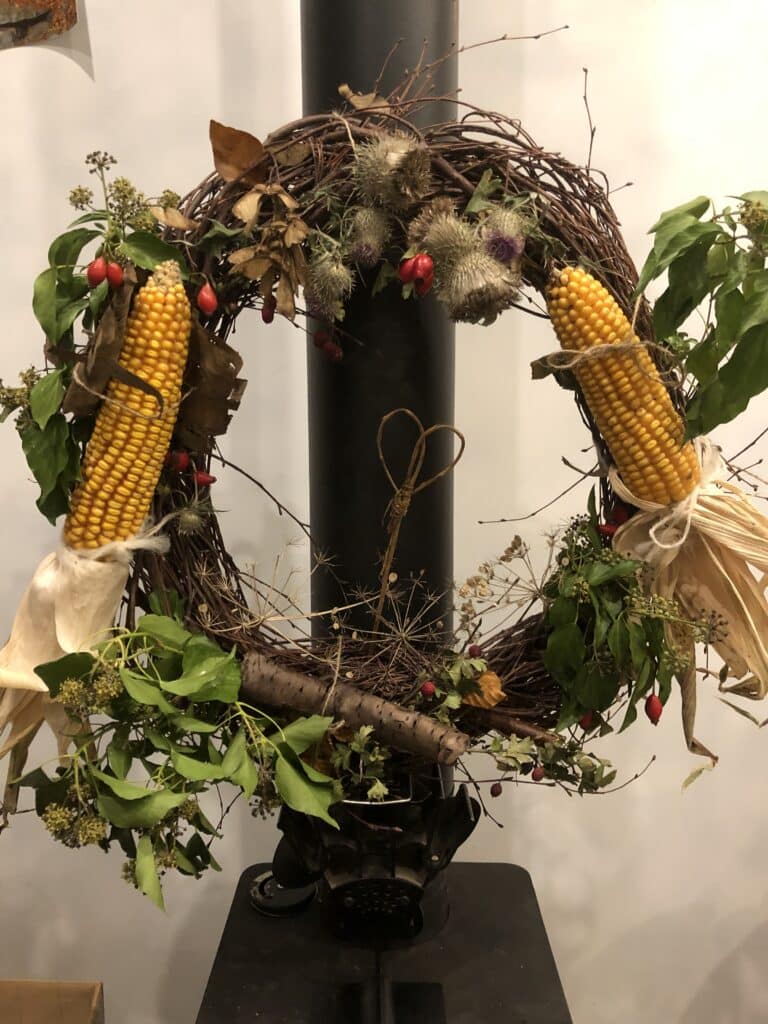
A wreath is not just for Christmas!
Having garnered inspiration from a good friend, my wreath is no longer just for Christmas as I alluded too earlier.
In November it has acorns, and chestnuts, oak galls, bright red ivy berries, ginkgo leaves from a beautiful walk with a friend in Sheffield Park, and acer leaves in their resplendent reds and oranges. These are the elements I carefully removed before redecorating for Christmas this year. At the end of summer my wreath has had golden yellow corn on the cob husks drying on it, interspersed with thistle heads, later into September, haws, rose hips, apple rings, and rowan berries, as the seasons progress and the leaves fall, dried leaves (leave them under a book in between a layer of newspaper for a week or so first – then they dry flat) in their resplendent reds and oranges and yellows. When the leaves fall, I start to notice the oak galls standing proud on the bare stems, so they are added to the wreath too, and the September berries as they fade are often replaced with holly and ivy seeds.
After my seasonal coppicing, I’ve been known to use the shoots from my willow beds that are too short for weaving to add a splash of colour to the wreath, and also to flower arrangements. Cornus works well for this as well.
In the spring I always add a few snowdrops, wrapped in a little parcel of kitchen roll or tissue to give them some water. They droop incredibly fast, but bring so much joy to me with the promise of lighter things to come that they have to come inside for a brief spell.
As the buds start to swell with the lengthening days, if you have a wreath you can water, such as the newspaper and moss one we mentioned earlier, you can bring in cuttings of willow, cornus, hazel and many other twigs and the warmth encourages the greening sooner. Bringing the longed for spring a little earlier inside. This works very well in a vase, but can be achieved for a shorter period on a wet wreath too. I love doing this with blackthorn as you get the heady white blossoms before the leaves.
Midsummer I often find my wreath is decorated with grass seeds, hogweed seeds and a huge array of different seed heads, that dry themselves out pointing at the sun.
Some years, as the seasons change the removed plants are kept for next year, they are just too delightful, or they are returned to the earth onto the compost heap. At times I’ve felt the need to mark the moment in a larger way, often with fire. Usually there is an aim for remembrance of what has passed that season and a thanking that I experienced it. Or at other times the burning is a symbolic letting go of a season or an event or feeling within it, with a thankfulness of the knowledge that ‘this too shall (or often) has pass(ed)’.
Please do let me know how you get on with your wreaths and if you want to what your decorations mean to you.